
The Pewter Moon
On the first hard frost of the season, a stranger sits too close to the fire and still does not warm.

These are short tavern tales from a world called Mistspire, where a cold night is best met with a fire and a full cup. Each one ends with a recipe you can make at home.
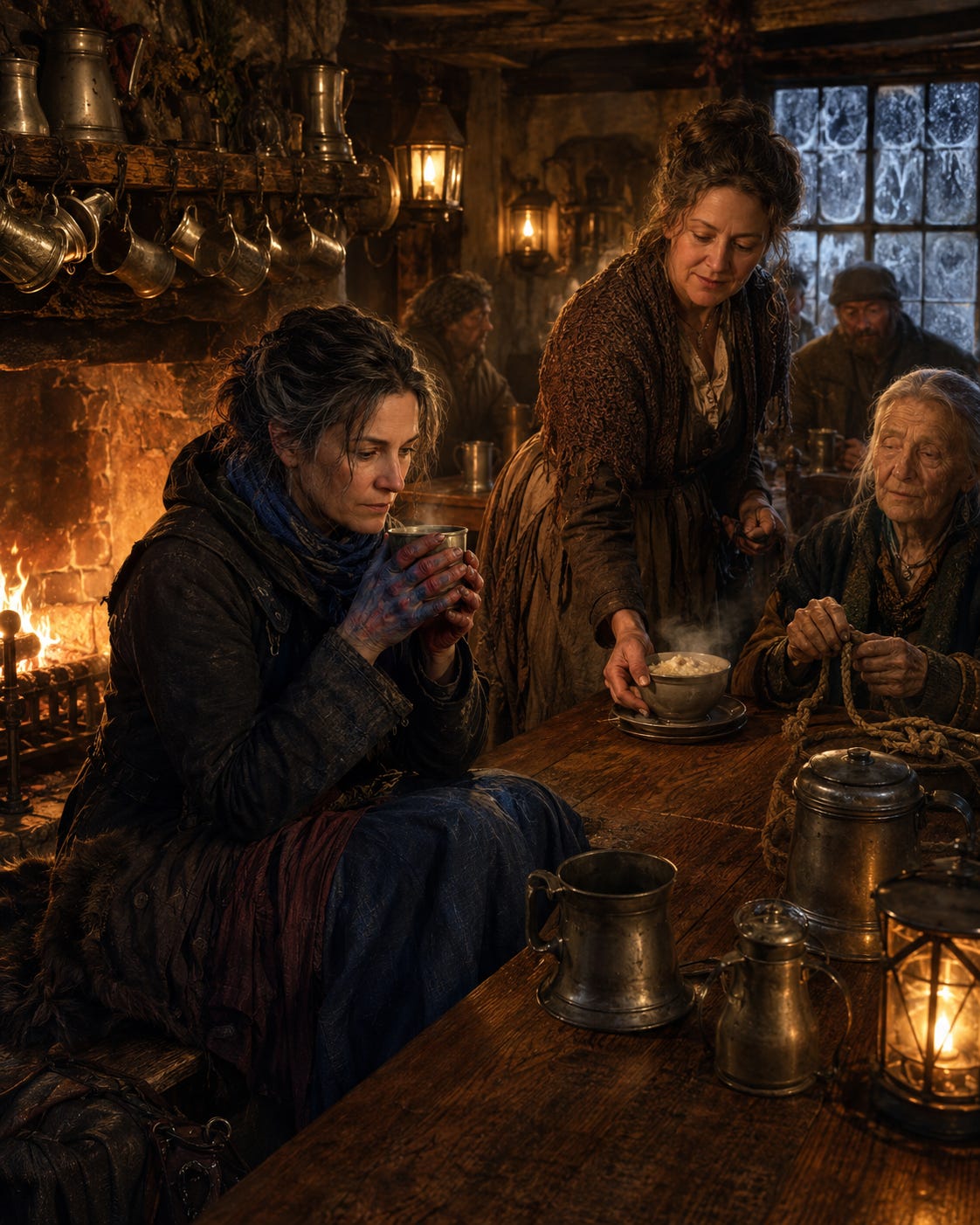
The Pewter Moon
A Mistspire tavern tale.
The first hard frost of the season came down on Millhaven the way it always did, quietly and all at once, so that the cobbles outside The Pewter Moon wore a skin of silver by the time Edna Colwell lit the second lamp. She lit it early on nights like this. The travelers who came in off the low road wanted to see a light before they saw a door, and Edna had never once made a cold guest hunt for her latch.
The tavern was small and it was hers, three years hers now, since Tomas had gone. It was a room a person could hold in one glance: a long hearth down the north wall, a scatter of oak tables gone the color of old honey, a bar no longer than a rowboat. Pewter mugs hung from their hooks in a row, dull and honest, catching the firelight without throwing it back. Edna had polished them once, early on, and found she preferred them soft. A bright thing asks to be looked at. A soft thing just lets you be.
By full dark the regulars had settled in. The old cooper nursed his one careful cup by the window. Two sisters argued about their brother without heat, the way they had for forty years. And in the seat nearest the fire, where she always sat, Old Cass turned her face toward the door each time it opened, reading the night by the cold that came in with it.
Cass had been a rope-braider once, the best in the river quarter, until her sight had left her twenty winters back. She had not slowed for it. She braided still, by touch, and she knew The Pewter Moon better than Edna did. She could tell you which table wobbled and which board by the cellar door had begun to sing when you stepped on it. She could tell you, most nights, who had come in before they said a word.
The door opened on a woman Edna did not know.
She came in on a gust of frost, a tall woman near Edna's own age, with a dyer's hands. You could not miss them. The nails were stained the deep blue of woad and the knuckles carried a wash of madder red that no scrubbing takes out, only time. She set down a pack that clinked with the small heavy weight of stoppered jars and looked around the room once, quick and level, the look of a person who has slept in a great many rooms and trusts none of them on sight.
"There's a bed if you want one," Edna said. "And a fire that's already lit. Sit where you like."
"Maret Solle." The woman gave her name the way she might hand over a coin, exact and no more. "A bed, yes. And whatever's hot."
She chose the bench closest to the hearth, which was sensible, and Edna thought no more of it until a quarter hour had passed and she noticed the thing she always noticed and wished, on nights like this, that she did not.
The fire was not warming Maret Solle.
It is a hard thing to describe to someone who has not kept The Pewter Moon. The hearth threw its heat as it always did; the cooper at the far window had loosened his collar, and the sisters had gone pink at the cheek. But the woman sitting almost close enough to singe her sleeve still held herself the way you hold yourself in the cold, shoulders drawn up small, hands folded tight, as though the warmth broke around her and closed again on the other side. She had not taken off her coat. She turned her cup between her palms and did not drink.
Edna had learned the hearth's logic without ever saying it aloud, not to Tomas while he lived and not to herself after. Some guests the fire would not reach. Never the tired ones, never the poor ones, never even the grieving, not simply for grieving. Only a certain kind of cold, the kind a person carries in from somewhere further off than the low road, and carries so long they have stopped feeling it as cold at all. Edna did not know how the hearth knew. She had stopped needing to. What she knew was what to do, which was less than people imagined and more than nothing.
She did not go to Maret. You do not go to a woman like that. You let the room do it.
The room, that night, was Old Cass.
"You work with your hands," Cass said, into the general quiet, not turning her head. It was not a question, so Maret did not treat it as one.
"I do."
"Wool," said Cass. "I can smell the mordant. Alum and something sour. Cream of tartar, if you're careful, and you smell careful." She braided as she spoke, a length of hemp cord moving through her fingers with no attention at all. "My mother dyed. Not for trade, just for us. I could tell the seasons by what came out of her pot. Onion skin in autumn. Woad she saved for the spring cloaks." She tipped her head. "You do it alone?"
Something in the room changed then, small as a draft under a door. Maret's hands went still on her cup.
"I do," she said again, and this time the two words cost her something.
"Hard trade for one," Cass said, comfortable, braiding. "The lifting alone. The pot's the least of it, it's the wet fleece after, forty pounds of it and no one to take the other end."
"I manage."
"Course you do." Cass let a beat go by. "Who taught you?"
And there it was, the plain question, set down on the table between them with no weight on it at all, the way Cass asked everything. Edna, drying a mug she had already dried, held her breath.
"My sister," Maret said.
The fire popped. No one filled the silence. That was the thing about The Pewter Moon that people never quite named when they tried to say why they came back. Nobody rushed you across your own quiet.
"She had the better eye," Maret went on, slower now, as if the words were being drawn up from a deep and half-frozen well. "For color, I mean. I mix by the recipe. She mixed by looking. She'd hold the wet skein up to the window and say, no, one more hour, and she was always right and I never once knew how she knew." A small breath that was not quite a laugh. "We had the trade between us. Two carts, two names, one dye-house. And then two summers back she folded her apron and set it on the bench and said she was done. Not the trade. Done with all of it. She went to her husband's people on the coast and she does not write and I do not write and I have told the story so many times that I dye alone now that I have half stopped believing there was ever anyone on the other end of the fleece."
She stopped. She looked, for a moment, surprised at herself, the way people do when a warm room and a blind woman's plain kindness have walked them further than they meant to go.
"That's the thing you've been carrying," said Cass gently. "Not that she left the trade. That she left it without telling you why."
Maret did not answer. But her shoulders, which had been drawn up small since the frost first blew her through the door, came down. Just a little. Just enough.
Edna was already moving. She had started before the words were finished, the way you learn to when a room is yours; she was at the little pan on the back of the range with the spiced apple poured and warming before she had decided to do it. This was the part that was hers to do. Not the question, that was Cass. Not the answer, that was Maret and no one else. Only this: the making of a warm thing and the setting of it down.
She warmed the spiced apple slow so it would not scald, cinnamon and a little clove going into it as it came up to heat. She whisked the yolks with honey and the good nutmeg, the grating one she kept for guests she meant to keep, and a small pinch of ginger for the cold in the bones. She heated the milk and the cream to a steam and no further, and tempered the two together with the patience of a woman who has ruined it once and does not mean to again, drawing the hot into the eggs a spoon at a time so nothing seized. She poured the warm spiced apple into the good pewter bowl, the one shaped like a little moon, and sent the hot spiced cream over it in a steady stream, and let it stand while it settled soft and warm and smelling of the orchard.
She ladled a cup with some of both and carried it over and set it in front of Maret Solle without a word, because some things you do not ask a person if they want. You simply decide they are had, and let them be had.
Maret looked at the cup. Then she wrapped both stained hands around it, the woad blue and the madder red going gold in the firelight, and she drank.
Edna watched the warmth find her. It was not sudden and it was not magic, or if it was magic it was the ordinary kind, the kind any full cup and any patient room can work. The color came up in Maret's face. The tight thing behind her eyes loosened. She sat a while with the cup between her palms, and then she did the thing the cold had not let her do since she came in, which was to take off her coat and hang it on the peg by the fire like a woman who meant to stay.
The hearth, for what it is worth, warmed her the rest of the night, the same as anyone.
Nobody said so. Cass went back to her cord. The sisters found a fresh grievance. The cooper slept a little in his chair. And Maret Solle sat in the good heat of The Pewter Moon and let the long night be long, which is a gift you cannot give yourself and can only be given.
In the morning she came down with her pack already shouldered and her hands scrubbed as clean as a dyer's hands ever get, and Edna thought she was for the road. But she set the pack by the door instead of taking it through.
"The frost'll hold another day," Maret said. "The low road's ice till noon at the earliest. It would be foolish to chance it." She looked at the hearth, cold now and swept, and then at Edna, and something honest passed over her face. "I'll take the bed another night, if it's free."
"It's free," said Edna.
"And I'll want that cup again this evening. If it's no trouble."
"It's no trouble," said Edna, and meant it, and went to see what the frost had done to the woodpile, so that the woman by the door would not have to be watched while her eyes went bright.
By the fire, Old Cass was already braiding. "Two nights," she said, to no one, pleased. "They always book the second night. It's the first one that's the work."
Edna smiled and did not answer, and outside the silver was already going to water in the thin new sun.
The Recipe: Hearth Apple Posset (alcohol-free)
The cup Edna sets before Maret without asking. A posset is an old hot drink, milk and cream gently thickened with egg yolk, spiced and sweetened, warm all the way down and made to soften a silence. This one is adapted from an old tavern posset and reworked with spiced apple and no alcohol, so the whole table can share a cup. Make it slow. The only way to spoil it is to hurry the heat.
Serves 2
What you need
360 ml (1 1/2 cups) apple juice
120 ml (1/2 cup) whole milk
120 ml (1/2 cup) heavy cream
2 large egg yolks
25 g (1 tbsp plus 1 tsp) honey or brown sugar
1 tsp lemon juice
1/4 tsp ground cinnamon
1/8 tsp ground ginger
a pinch of ground nutmeg, plus a little more to finish
a tiny pinch of ground cloves
a pinch of fine salt
How to make it
In a small pan, warm the apple juice with the cinnamon, ginger, nutmeg, cloves, and salt to a bare simmer, about 80 to 85 C (175 to 185 F). Keep it warm on low.
In a bowl, whisk the egg yolks with the honey or brown sugar until smooth.
In a second pan, heat the milk and cream together until steaming, about 75 to 80 C (170 to 175 F).
Temper the yolks: whisk a few spoonfuls of the hot milk into the egg mixture, one spoon at a time, then whisk all of it back into the pan.
Cook over low heat, stirring constantly with a wooden spoon, until slightly thickened and able to coat the spoon, about 71 to 74 C (160 to 165 F). Do not let it boil or the yolks will scramble.
Take both pans off the heat. Stir the lemon juice into the hot spiced apple, then slowly whisk in the hot milk mixture. This combined cup is your posset. Let it stand 1 minute; it will stay mostly smooth with only the faintest soft flecking.
Pour the posset into mugs and grate a little more nutmeg over the top. Serve warm. For a perfectly smooth cup, strain it as you pour.
Next time: a different tavern, a different night. There is a traveler with a story he has told before, and a young cook keeping the fire alone for the first time. The recipe at the end is a chili. It earns its place.
Liam Ketz